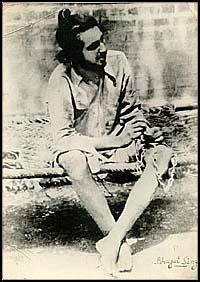
Born on 28 September 1907, 1924 was the turning point in Bhagat Singh;s life. On being pressurized for marriage, he ran off to kanpur where he started reporting for the Hindi newspaper ‘Pratap’ and also joined Chandrashekhar Azad’s Hindustan Republican Association (HRA). In 1925, he returned to Lahore; started a militant youth organization called Naujawan Bharat Sabha and helped Sohan Singh Josh in April 1926 establish the Worker’s and Peasants Party; was first arrested in 1927 on charges of explosion at Lahore and after his release, led the HRA in 1928 and renamed it as HRSA.
Retaliating against Lala Lajpat Rai’s killing, Bhagat Singh and his associates eliminated policemen Saunders in 1928.
In April 1929, Bhagat Singh and Batukeshwar Dutt threw bombs into the Delhi assembly to protest against the Trade Dispute Bill and he was sentenced to life imprisonment on 12 June. A gun factory was unearthed at Lahore and Sukhdev and others were arrested; on 10th July 1929, the Lahore Conspiracy case began and ended with the death penalty for Bhagat Singh on October 7, 1931.
Bhagat Songh was a real life hero who bore police torture bravely and sacrificed his life to free India. (Ajoy Ghosh, co-accused and general secretary of CPI in independent India writes “In July 1929 we were produced in court …met Bhagat Singh … he was carried into the court on a stretcher. For months he and Dutt had been tortured by the police”).
He had an irrepressible sense of black humour. When his tearful father told him that the hanging would take place by March end, he replied “Chalo accha hai”. In Lahore’s hot summer, “Kothri mein bhunne se accha marna hai”, he said.
He also had a romantic side to his personality. Once when sukhdev accused him of being in the clutches of a woman (the reference was to Durga Devi who planned the train getaway after the Saunders’ killing), Bhagat Singh cited the case of Mazzini – after repeated failures in his revolutionary attempts, it was a girl’s love which saved him from madness and suicide. He wrote “eik krantikari (revolutionary) ke jeevan mein prem (love) koi bemail cheez nahi hai.” However, Bhagat Singh’s character and respect for freedom fighter Bhagwati Charan Vohra’s wife Durga Devi is reflected in the same letter, “Main ye keh sakta hoon ki aapas mein pyar kar sakte hain aur apne pyar ke sahare apne aavegon (passions) se oopar utth sakte hain. Apni pavitrata (here it means fidelity) kaayam rakh sakte hain.”
A voracious reader he wrote from proson (24th July 1930) to his friend jaidev. “Please take the following books from Dwarkadas Library and send it through Kulvir (Bhagat’s brother): ‘Militarism’ by Karl Liebknecht, ‘Why Men Fight’ by Bertrand Russell, ‘Soviets at Work, Collapse of the Second Intrernational’, ‘Let Wing Communism by Lenin, ‘Mutual Aid by Prince Kropotkin, ‘fields, factories and workshops,’ ‘civil war in France’ by Marx, ‘Land Revolution in Russia’, ‘Punjab Peasant in Prosperity and Debt’ by Darling, ‘Historical Materialism’ By Bukharin and a novel ‘Spy’ by Upton Sinclair.”
A prolific writer too, he wrote in Punjabi, English, Urdu and Hindi. Apart from writing letter and 400 page jail notebook, Bhagat Singh wrote three monographs: “Why I became an Atheist”, “The philosophy of the bomb” and “A letter to young political workers”.
His political sense was superb – whether in chucking bombs into the assembly to spread the freedom call of revolutionaries countrywide; using the prison term contemplate and write on socialism, revolutions, history of revolutionaries in India, Ireland and elsewhere; the decision to go to an indefinite hunger strike in prison urging prison reforms that galvanized the entire nation; to use the court room and resultant media publicity to get his message across etc – all these show that the 23 years old Indian Revolutionary was politically far precocious than Lenin, Mao and Che Guevara.
Young Indians are not excited by political personalities, as most contemporary politicians are dull and uninspiring.
However they can draw inspiration from Bhagat Singh’s struggle for the principles of justice and equality. As a first step, the GenNext could jettison their flimsy cricketing and filmy icons and start reading up on Bhagat Singh to keep memory of the martyr fresh.
The writer teaches at National Law Institute University, Bhopal and can be contacted at crsekhar2001@yahoo.co.in